New Year 2026
Published:
It’s 2026! Let me update with some news from the latter parts of last year:
Our group has a new PhD student! Welcome to Lloyd La Ronde. I don’t think he has a University profile page up, so let me link to his substack instead, where you can read his thoughts on quantum computing. He is working on developing fault-tolerant quantum algorithms for nuclear structure. He is funded by an AWE studentship, working with our visiting professor James Benstead and co-supervised by Matteo Vorabbi. Welcome, Lloyd!
We also celebrate the graduation of Grant Close who successfully defended his PhD thesis last month and now is working as an industrial scientist. Well done, Grant!
Serkan Akkoyun has joined us as a year-long visitor. He is from Sivas Cumhuriyet University in Türkiye and he is the recipient of a Turkish scholarship allowing him to work abroad for a year. He has choseon to come to us to work on a combination of machine learning and quantum computing for nuclear physics applications. Welcome, Serkan!
There are quite a few new publications since I last udpated (early June ‘25), so let me summarize them all here:
- The first major part of Isaac Hobday’s thesis was published in Phys. Rev. C describing the calculation of excited states in nuclear models using a variance minimization method. There are results from the use of real quantum computers in there, and it is great that Isaac was able to get this out having moved to the University of Glasgow to undertake a postdoc there. This leaves one major part of Isaac’s thesis awaiting a publication, which sits somewhere on my to-do list now that Isaac has moved on.
- It was in the last update that Grant’s work on 12C—12C collisions had appeared on the arXiv. Now it is published in Phys. Lett. B.
- The proceedings of the Compound Nuclear Reactions ‘24 conference are published, including my contribution which is an exploration of nonlinear large-amplitude excitations in 232Th of the sort that could lead to photo-fission. I’d like to develop these into more serious calculations, but that awaits some technical developments.
- Work with Miriam Davies, a PhD student of my colleague Esra Yüksel, with me as second supervisor, led to a Phys. Rev. C publication on α-particle clustering in 16O.
- A preprint on arXiv was submitted by another PhD student I co-supervise. This time, it’s Nick Lightfoot, whose main supervisor is Alexis Diaz-Torres and the paper looks at thermal effects on neutron capture reactions of a sort that are relevant for nuclear astrophysics.
- The proceedings of a conference I attended in Türkiye last year, have been published. It is a co-authored work between me and several others, particularly highlighting some work of Lloyd La Ronde (new PhD student as mentioned above) and Robbie Giles that both undertook while doing their MSc projects last year. I’m not sure if the proceedings will have a permanent publicly-accessible link, but here is a preprint of the paper, which combines an introduction to quantum computing as applied to nuclear structure, with some sample calculations.
- Chandan Sarma and I have written up some work on using a novel ansatz to encode nuclear shell model problems onto quantum computer. It uses shell model configurations as the basic unit to be encoded, which results in low circuit depths at the cost of more qubits needed. This is useful for some of today’s noisy quantum computers with lots of qubits - such as those from IBM. Indeed, we accessed the IBM machines thanks to an NQCC grant to show how the method worked. The paper is under consideration by Discover Quantum Science
- Our visitor Serkan has used his time at Surrey to look at the use of quantum computing in machine learning methods and submitted a first preprint looking at this
- Finally … I have started a collaboration with Bhoomika Maheshwari from GANIL, looking at further developing some of the methods of using quantum computers for nuclear structure. A first preprint - destined for the proceedings of the Polish Mazurian Lakes conference - is available.
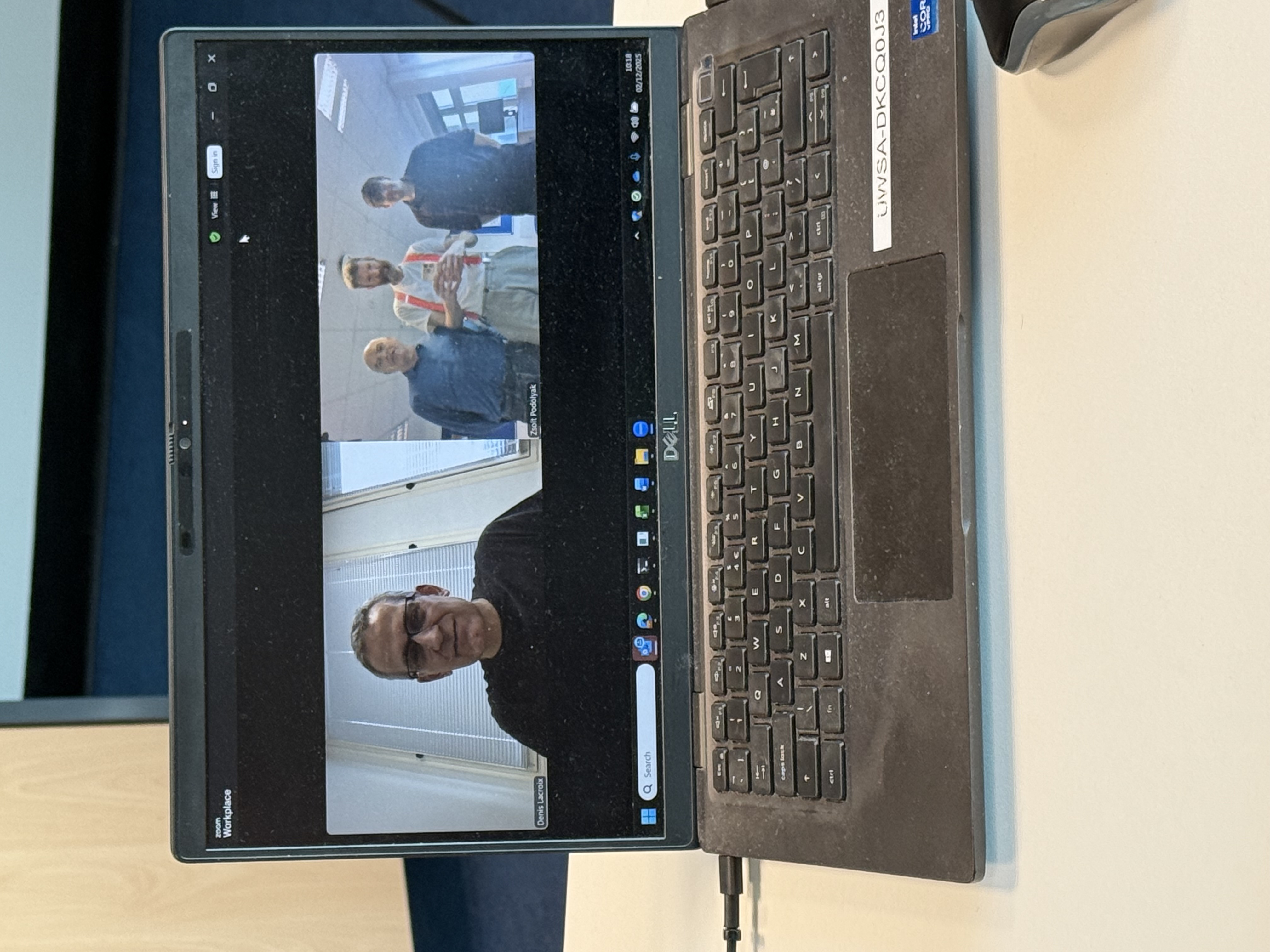
To finish with, here’s a picture taken at the end of Grant Close’s PhD viva, showing (L-R) external examiner Denis Lacroix, internal examiner Zsolt Podolyák, me, and successful PhD-defender Grant. The viva took place online, as is the default now, hence the photo of the computer screen!